Autism and Masking in Girls: Why It Is Missed and How to Help
Why autistic girls are often identified later, what masking looks like at home and at school, and practical ways adults can lower the cost of coping.
ABy Apurva Somvanshi19 March 20258 min read
Work with me
Book a session
One-to-one support for children, parents and young professionals.
See programmesSome autistic girls get through the school day looking settled. They copy the way their friends sit, laugh when the group laughs and answer when they are asked. Then they come home and fall apart. Parents are told “she’s fine in class”, and they start to wonder whether they are imagining things.
They usually are not. What is often happening is masking, sometimes called camouflaging, and it is one of the main reasons autistic girls are identified later than boys.
What masking means
Masking is the effort an autistic person puts into hiding or compensating for their autistic traits so that they fit in. The NHS describes it simply: some people learn to adapt so that signs of autism are less noticeable, and this can be tiring. The NHS also points out that not every autistic person knows they are doing it.
Laura Hull, William Mandy and colleagues interviewed autistic adults about camouflaging in a 2017 study called “Putting on my best normal”. The same team later built a questionnaire, the CAT-Q (Hull et al., 2019), which groups camouflaging into three broad kinds of effort:
- Masking: hiding autistic characteristics, such as suppressing stimming or forcing eye contact.
- Compensation: finding workarounds for social difficulties, such as rehearsing conversations or studying how other people talk.
- Assimilation: trying to blend in, often by performing a role in social situations that feel uncomfortable.
The adults in the 2017 interviews talked about the short-term gains. They avoided being singled out and they kept friendships going. They also described the costs, including exhaustion, anxiety and a sense of losing track of who they really were.
Masking is not lying, and it is rarely a deliberate plan. For many children it is a learned survival strategy that builds up after years of being corrected, teased or simply noticing that they are different.
Why girls are identified later
Far more boys than girls are diagnosed as autistic. A meta-analysis by Rachel Loomes, Laura Hull and William Mandy (2017) estimated the true male to female ratio at around three to one, lower than the four to one figure often quoted. Their conclusion was that some girls who meet the criteria are not being identified.
There are a few reasons for this.
Diagnostic descriptions and screening tools were developed mostly from studies of boys. A girl whose special interest is horses, a pop band or a particular book series may not look “unusual” in the way that an intense interest in train timetables did to an earlier generation of clinicians. The interest may be just as absorbing. It just blends in.
Expectations of girls are different too. Quietness, compliance and staying close to one friend can all be read as shyness or good behaviour in a girl. The same pattern in a boy might prompt a question.
Research also suggests that girls may need more obvious difficulties before anyone acts. Katharina Dworzynski and colleagues (2012), using UK twin data, found that girls who met diagnostic criteria were less likely than boys to have a diagnosis unless they also had additional behavioural or intellectual difficulties.
None of this means that every quiet girl is autistic, or that boys do not mask. The NHS is clear that autistic boys can mask too. It means that the usual signals adults look for can be harder to see.
Signs that a child may be masking
The NHS lists some ways autism may show up in girls. Autistic girls may:
- copy how other children behave and play
- be quiet in situations they find difficult
- appear to cope with social situations
- show fewer signs of repetitive behaviours than autistic boys
- be more likely to have mental health problems, such as anxiety, depression or an eating disorder
In school, I find the clues are often in the gaps between settings. A pupil who is calm and polite in lessons may be very different at lunch, during group work or on a trip, when the rules are less clear and the social demands go up. Some other things adults might notice:
- Big differences between how a child is at school and how she is at home, especially after school or on Sunday evenings.
- Friendships that look fine from a distance but turn out to be intense, one-sided or frequently breaking down.
- A child who watches others closely before joining in, as though learning a script.
- Very high standards, perfectionism, or real distress over small mistakes.
- Sensory discomfort that is tolerated quietly, such as noise, labels in clothes or the smell of the canteen.
- Frequent headaches, stomach aches or tiredness with no clear cause.
- Increasing reluctance to go to school, sometimes building over months.
One sign on its own tells you very little. A pattern across several of these, lasting for a while, is worth talking about.
The cost of keeping it up
The research on camouflaging is still developing, and most of it involves adults looking back rather than children. Even so, the findings point in a consistent direction. A systematic review by Julia Cook, Laura Hull, Laura Crane and William Mandy (2021) in Clinical Psychology Review found that camouflaging was associated with poorer mental health, including anxiety, depression and stress, though the authors note that much of the evidence is cross-sectional, so it cannot show cause and effect.
For a child, the practical point is simpler. Holding yourself together for six hours uses energy. When that energy runs out, it often runs out somewhere safe, which usually means at home. A parent who is the target of the after-school explosion is not doing anything wrong. They are, in a sense, the person the child trusts enough to stop performing for.
Support at home
You do not need a diagnosis to start making things easier.
Build in recovery time after school. Many children need quiet before they can talk about the day, eat properly or start homework. A snack, a familiar activity and no questions for half an hour can make a real difference to the evening.
Keep a simple diary. Note the date, what happened at home, and anything you know about the day at school. Over a few weeks this can show patterns, such as harder evenings after PE or supply teachers, and it gives you something concrete to share with professionals.
Make home a place where she does not have to mask. That might mean allowing stimming, letting her talk at length about an interest, or dropping expectations of eye contact during conversations. Small permissions add up.
Talk about differences positively. Children who mask often believe something is wrong with them. Language that treats different ways of communicating as valid, rather than as faults to hide, helps. The idea behind the double empathy problem is useful here: communication difficulties between autistic and non-autistic people run in both directions.
Look after friendships, gently. Some autistic girls do best with one or two close friends who share an interest. That is a perfectly good social life.
Support at school
Share what you see at home with the school. Staff can only respond to what they know, and a child who masks may give them very little to go on. The SENCO is the right person to start with, and working with your child’s SENCO covers how to make that conversation productive.
Some adjustments that often help, whether or not a child has a diagnosis:
- A named adult she can go to, and a quiet place she can use without having to explain why.
- Clear, predictable routines, with warning when something changes. Our guide to helping autistic children with transitions has practical ideas.
- Structured group work, with roles assigned rather than left to pupils to negotiate.
- Attention to the sensory environment, especially in busy spaces such as the dining hall.
- A discreet way to ask for help, such as a card on the desk, so she does not have to put her hand up in front of everyone.
Staff can also watch for unstructured times. A short check-in at the end of lunch can tell an adult much more than a calm maths lesson does.
Getting an assessment
If you think your daughter may be autistic, talk to your GP, the school SENCO, or your health visitor for younger children. In England, referrals for assessment are made to local NHS services, and the National Institute for Health and Care Excellence (NICE) guidance on autism in under-19s sets out how recognition, referral and diagnosis should work. Waiting lists in many areas are long, which is another reason to ask for support from school in the meantime. Support in school should be based on need, and a child does not need a diagnosis to receive SEN support.
When to get help sooner
Please do not wait for an autism assessment if your child shows signs of significant distress. Speak to your GP promptly if she is withdrawing, not eating properly, refusing school, self-harming or talking about not wanting to be here. The GP can refer to NHS Child and Adolescent Mental Health Services (CAMHS). If you are worried about her immediate safety, call 999 or go to A&E.
Further reading
- Cook, J., Hull, L., Crane, L. and Mandy, W. (2021). Camouflaging in autism: a systematic review. Clinical Psychology Review, 89, 102080.
- Dworzynski, K., Ronald, A., Bolton, P. and Happé, F. (2012). How different are girls and boys above and below the diagnostic threshold for autism spectrum disorders? Journal of the American Academy of Child and Adolescent Psychiatry, 51(8), 788-797.
- Hull, L. et al. (2017). “Putting on my best normal”: social camouflaging in adults with autism spectrum conditions. Journal of Autism and Developmental Disorders, 47(8), 2519-2534.
- Loomes, R., Hull, L. and Mandy, W. P. L. (2017). What is the male-to-female ratio in autism spectrum disorder? A systematic review and meta-analysis. Journal of the American Academy of Child and Adolescent Psychiatry, 56(6), 466-474.
- NHS. Signs of autism in children. nhs.uk.
- National Institute for Health and Care Excellence (2011, updated 2017). Autism spectrum disorder in under 19s: recognition, referral and diagnosis (CG128).
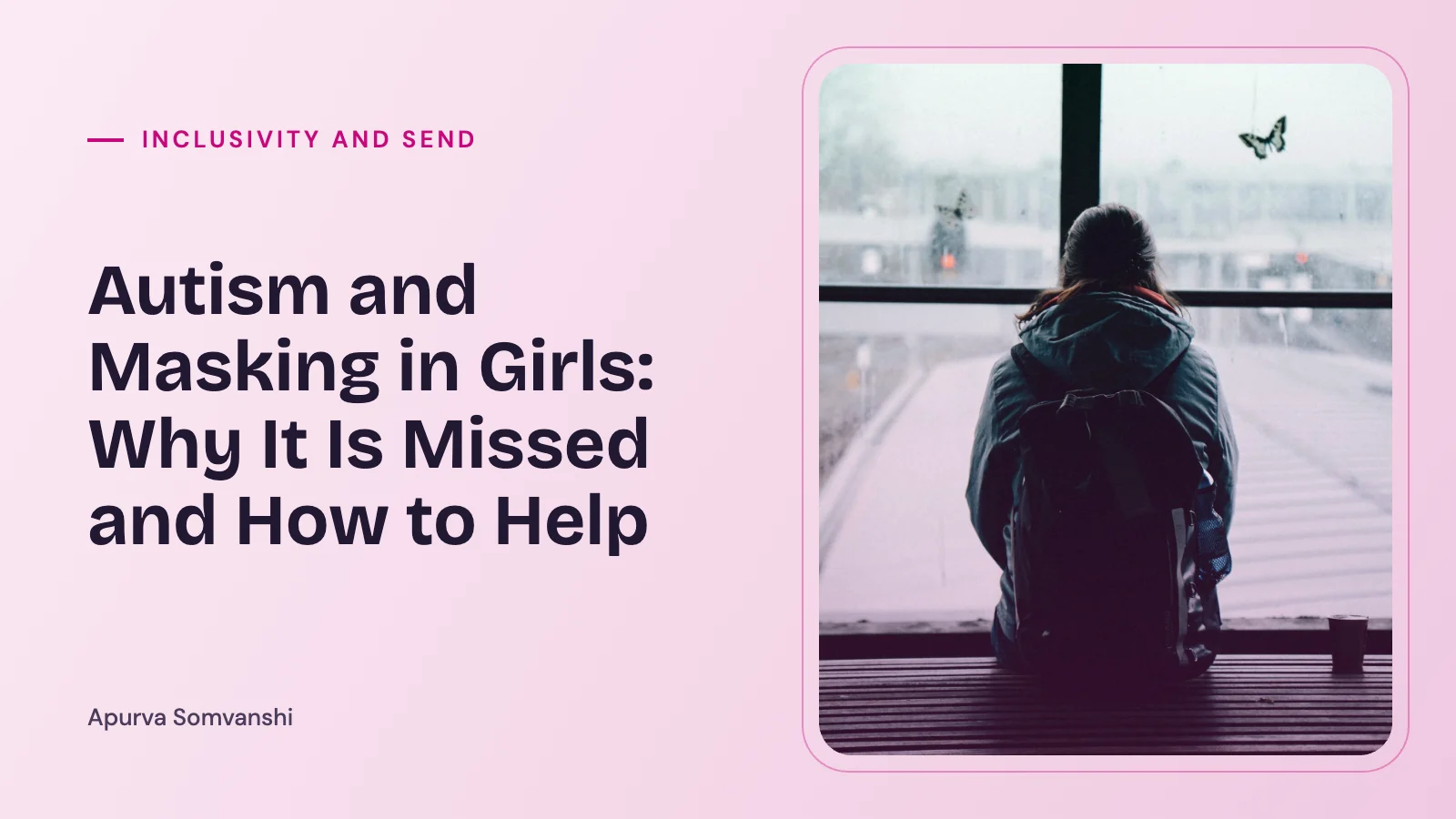
Cover image: Photo by Danique Veldhuis on Unsplash.
Worth remembering
A parent who gets the after-school explosion is often the person the child trusts enough to stop performing for.
Try this
After school this week, offer a snack, a familiar activity and no questions for half an hour before talking about the day.
Check what stuck
Tap a card to turn it over.
Apurva Somvanshi
Educator working in inclusive practice and SEND across primary and secondary schools, currently studying for an MSc in Psychology. I write about how children learn, how parents can help, and how adults can live with more attention.
Read my storyKeep reading

Inclusivity and SEND 3 min read
Inclusive Language in Classrooms: Small Words, Clear Signals
Inclusivity and SEND 7 min read
Dyscalculia: Signs by Age and How to Support a Child with Maths

Inclusivity and SEND 5 min read
Learning Strategies That Support Neurodivergent Children: Practical Techniques for Inclusive Learning
Questions about your child, your class or your next step? Let us talk.
Tell me a little about what is going on and I will reply within a few days.