Supporting Speech and Language Needs at Home
Everyday ways to support a child's speech, language and communication at home, and signs that it is time to ask about a speech and language therapy referral.
ABy Apurva Somvanshi8 November 20256 min read
Work with me
Book a session
One-to-one support for children, parents and young professionals.
See programmesSpeech, language and communication needs, often shortened to SLCN, are the most common primary need recorded for pupils receiving SEN support in England. The Department for Education’s 2025/26 figures put them at about one in four of those pupils. They cover a wide range. Some children find certain sounds hard to say. Some understand far less than people assume. Some speak in full sentences but struggle to follow a story, take turns in a conversation or explain what happened at lunch.
Parents are in a strong position to help. Most of the useful things happen in ordinary moments, and none of them need special equipment.
Speech, language and communication: three different things
It helps to separate these out, because the support is different for each.
Speech is the physical production of sounds. A child who says “tat” for “cat” at seven, or who is hard for strangers to understand, may have a speech sound difficulty.
Language is about words and how they fit together. It has two sides: understanding what others say (receptive language) and putting thoughts into words (expressive language). Difficulties with understanding are easy to miss, because children become very good at following routines and copying others.
Communication is how we use speech and language with other people: listening, turn-taking, reading facial expressions, adjusting to the situation.
How common are language difficulties?
More common than most people expect. Courtenay Norbury and colleagues screened over 7,000 children starting school in Surrey and published their findings in 2016. They estimated that 7.58% of children had developmental language disorder (DLD), a persistent language difficulty with no known cause. That works out at roughly two children in every class of 30.
The term DLD was agreed by an international panel of experts in the CATALISE studies, led by Dorothy Bishop and published in 2016 and 2017. Many children with DLD are not identified until later in school, if at all, partly because their difficulties can be mistaken for poor behaviour or low effort.
Everyday ways to help at home
Get face to face
Sit or crouch at your child’s level. It is easier for them to watch your mouth, read your expression and feel that you are paying attention. This matters more than any particular activity.
Observe, wait, listen
The Hanen Centre, a Canadian organisation whose parent programmes are used by speech and language therapists in the UK, uses the shorthand OWL: observe, wait, listen. Watch what your child is interested in. Wait, longer than feels natural, so they have a chance to start. Then listen to whatever they offer, whether it is a word, a gesture or a sound.
Many adults fill silences too quickly. Children with language difficulties often need extra processing time before they can respond.
Comment more, question less
A string of questions (“What’s that? What colour is it? What’s it doing?”) can feel like a test. Try commenting on what your child is doing instead: “You’re building a tall tower. It’s wobbly!” Comments give your child language to borrow without putting them on the spot.
Add a little more
If your child says “car”, you might say “red car” or “fast car”. If they say “dog running”, try “the dog is running to the gate”. Keep your version just one step ahead of theirs. This is sometimes called expanding.
Model, don’t correct
If your child says “I goed to the park”, there is no need to stop them. Reply naturally with the correct form: “You went to the park? What did you do there?” They hear the right version in a warm, real conversation.
Make routines talking time
Bath time, getting dressed, cooking and walking to school happen every day. Using the same words in the same routines gives children many chances to hear and try them. Our piece on serve and return conversations explains why these back-and-forth exchanges matter so much for young children.
Share books, and talk about them
You do not have to read every word. Talk about the pictures, guess what will happen next, and link the story to your child’s own life. Rereading favourites is useful, because familiarity frees children to join in.
Use your home language
If your family speaks a language other than English at home, keep using it. Rich conversation in any language builds the understanding that supports English too. Our article on raising bilingual children goes into this in more detail.
Reduce background noise
Television, music and screens in the background make it harder for children to tune in to speech. Short periods of quiet, face-to-face talk are more useful than long periods of half-attention.
When to ask about a referral
Children develop at different rates, and many catch up. But some signs are worth acting on. Talk to your health visitor, GP, nursery or school SENCO if your child:
- is not babbling, pointing or responding to their name by around 12 months
- has very few words, or is not putting words together, by around two
- is hard for family members to understand at three
- often seems not to understand simple instructions, especially without gestures
- is frustrated, withdrawn or having frequent meltdowns linked to communication
- has stopped using words or skills they used to have
- stammers in a way that worries you or them
Our guide to language development milestones from 0 to 5 gives a fuller picture of typical ages.
Ask for a hearing test as well. Hearing difficulties, including temporary ones such as glue ear, can affect speech and language and are easy to check.
In many areas of England, parents can refer their child directly to the local NHS speech and language therapy service. In others, a referral goes through the health visitor, GP or school. Your local service’s website or your GP practice can tell you which applies.
If your child is at school, the SENCO can arrange support and, where needed, involve a speech and language therapist. It is worth writing down your concerns before that conversation, with examples of what you notice at home.
Losing skills your child already had should always be raised with your GP promptly.
Further reading
- Bishop, D. V. M. et al. (2017). Phase 2 of CATALISE: a multinational and multidisciplinary Delphi consensus study of problems with language development: terminology. Journal of Child Psychology and Psychiatry, 58(10), 1068-1080.
- I CAN and Royal College of Speech and Language Therapists (2018). Bercow: Ten Years On. An independent review of provision for children and young people with speech, language and communication needs in England.
- Norbury, C. F. et al. (2016). The impact of nonverbal ability on prevalence and clinical presentation of language disorder: evidence from a population study. Journal of Child Psychology and Psychiatry, 57(11), 1247-1257.
- Speech and Language UK (formerly I CAN). Information and advice for parents. speechandlanguage.org.uk.
- The Hanen Centre. Resources for parents. hanen.org.
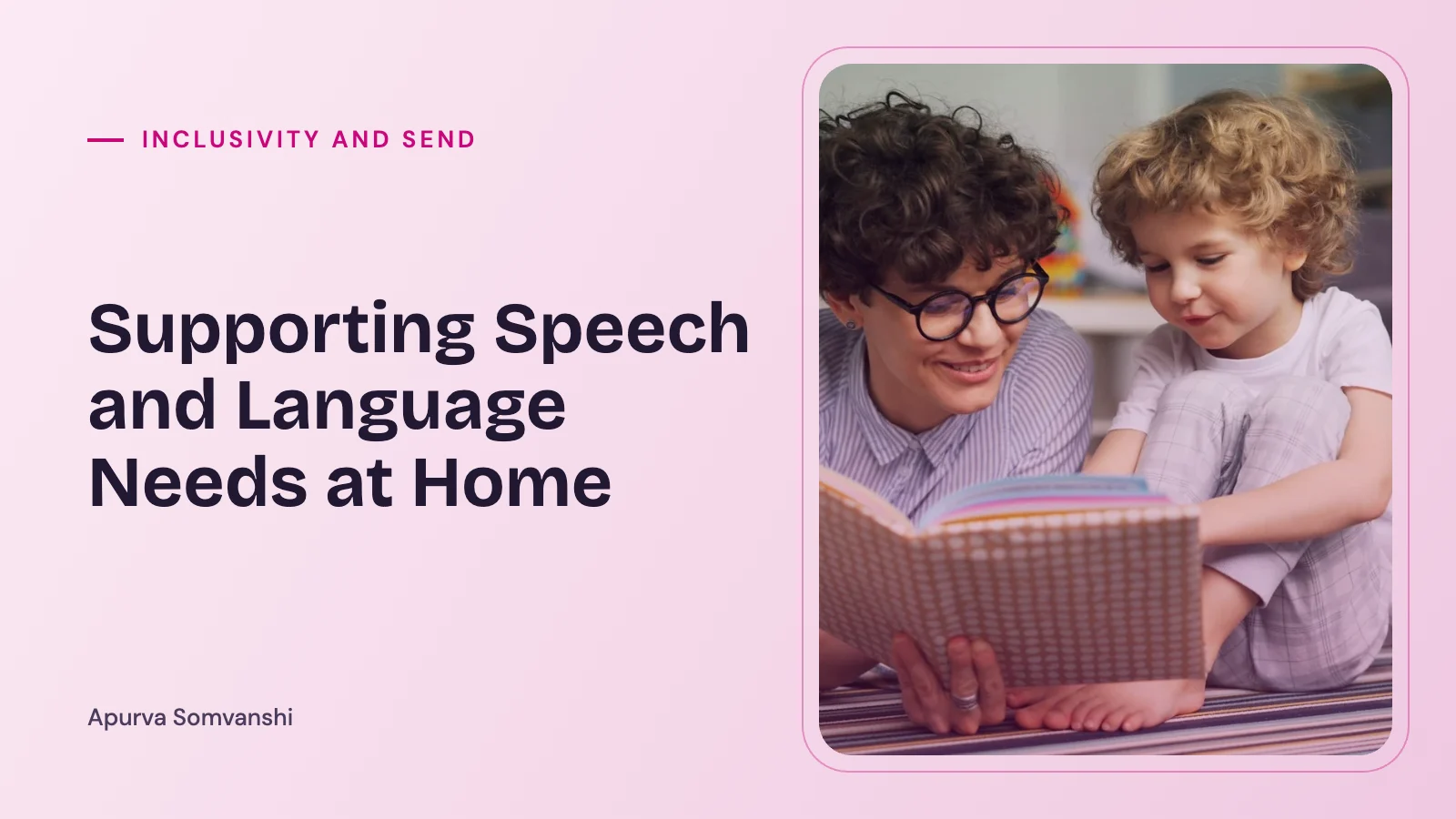
Cover image: Photo by Vitaly Gariev on Unsplash.
Worth remembering
Difficulties with understanding are easy to miss, because children become very good at following routines and copying others.
Try this
During bath time or a walk this week, comment on what your child is doing instead of asking questions, then wait.
Check what stuck
Tap a card to turn it over.
Apurva Somvanshi
Educator working in inclusive practice and SEND across primary and secondary schools, currently studying for an MSc in Psychology. I write about how children learn, how parents can help, and how adults can live with more attention.
Read my storyKeep reading

Inclusivity and SEND 3 min read
Inclusive Language in Classrooms: Small Words, Clear Signals
Inclusivity and SEND 7 min read
Dyscalculia: Signs by Age and How to Support a Child with Maths

Inclusivity and SEND 5 min read
Learning Strategies That Support Neurodivergent Children: Practical Techniques for Inclusive Learning
Questions about your child, your class or your next step? Let us talk.
Tell me a little about what is going on and I will reply within a few days.