Walking as Thinking Time: Why Ideas Come Easier on Your Feet
Walking can loosen up stuck thinking. What the Stanford walking study found, where its limits are, and simple ways to use a walk as daily thinking time.
ABy Apurva Somvanshi27 March 20255 min read
Work with me
Book a session
One-to-one support for children, parents and young professionals.
See programmesMost of us have had the experience of giving up on a problem at the desk, going out for some air, and finding the answer arrives somewhere between the front door and the end of the road. It is easy to dismiss that as coincidence. There is some good evidence that it isn’t.
What the walking study found
In 2014, Marily Oppezzo and Daniel Schwartz at Stanford published a set of four experiments with a memorable title: “Give your ideas some legs”. They asked 176 people, mostly university students, to do creativity tasks while sitting or while walking. The main task asked people to think of unusual uses for everyday objects, such as a button or a tyre. This measures divergent thinking, the kind where you generate lots of possible answers.
Walking made a clear difference. Across the experiments, most people produced more novel ideas when walking than when sitting. In one experiment every participant did. Walking on a treadmill facing a blank wall worked about as well as walking outside, which suggests the movement itself was doing much of the work, and not only the change of scenery. There was also a carry-over effect: people who walked and then sat down still did better than those who had sat throughout.
There was a catch worth knowing about. On a task with one correct answer, which needs focused, convergent thinking, walking gave no advantage and walkers did slightly worse. So a walk seems to be good for generating options and less useful for checking a calculation or proofreading a letter.
Why this might help
The study was not designed to explain the mechanism, and I would be careful about claiming more than it shows. Still, it fits with what many people notice. Walking at an easy pace is rhythmic and needs very little attention, which seems to leave the mind free to wander and connect things.
Time outdoors has its own research. Gregory Bratman and colleagues (2015) found that people who took a 90-minute walk in a natural setting reported less rumination afterwards than people who walked the same time beside a busy road. Rumination is that repetitive loop of negative thought many of us know well. A short study cannot tell us everything, but it is a reasonable argument for choosing the park over the main road when you can.
Making a walk your thinking time
You don’t need a long hike. In term time, I find that even a short walk after school helps separate the working day from the evening, and it is often when planning for the next day starts to take shape. A few ways to make it useful:
- Take one question with you. Before you go, name the problem you want to think about, such as how to explain a topic, or what to say in a difficult email. Then let your mind do what it likes.
- Leave the headphones off sometimes. A podcast is pleasant, but it fills the space where your own thoughts would go.
- Capture ideas quickly. A voice note or a line in your phone is enough. Ideas from a walk fade fast.
- Do the checking later. Since walking seems to help with generating ideas more than evaluating them, sort through what you came up with once you are back at a table.
- Walk with someone for a different kind of thinking. Talking a problem through side by side often feels easier than sitting face to face, especially for conversations that feel awkward.
For children and young people
The same idea can work for children who find it hard to talk or think when sitting still. A walk to the shop can be a gentler time for a chat about school than a conversation across the kitchen table. Some schools build movement breaks into the day for similar reasons. If your child seems to think better on the move, that is useful to share with their teacher.
Walking and health
The UK Chief Medical Officers recommend that adults aim for at least 150 minutes of moderate activity a week, and brisk walking counts. The NHS has simple guidance on walking for health, including how to start if you have been inactive for a while. If you have a health condition or pain when walking, speak to your GP before increasing how much you do.
A walk will not solve every problem. It is a cheap, low-effort way to give your thinking more room, and for many of us that is enough reason to go.
If you want to keep what comes up on your walks, a few lines in a notebook help. Journaling for busy people has some short prompts, and the art of slowing down looks at why unhurried time matters. For screen-free breaks more generally, see digital rest for adults.
Further reading
- Oppezzo, M. and Schwartz, D. L. (2014). Give your ideas some legs: the positive effect of walking on creative thinking. Journal of Experimental Psychology: Learning, Memory, and Cognition, 40(4), 1142-1152.
- Bratman, G. N., Hamilton, J. P., Hahn, K. S., Daily, G. C. and Gross, J. J. (2015). Nature experience reduces rumination and subgenual prefrontal cortex activation. Proceedings of the National Academy of Sciences, 112(28), 8567-8572.
- UK Chief Medical Officers (2019). UK Chief Medical Officers’ Physical Activity Guidelines. Department of Health and Social Care.
- NHS. Walking for health. nhs.uk.
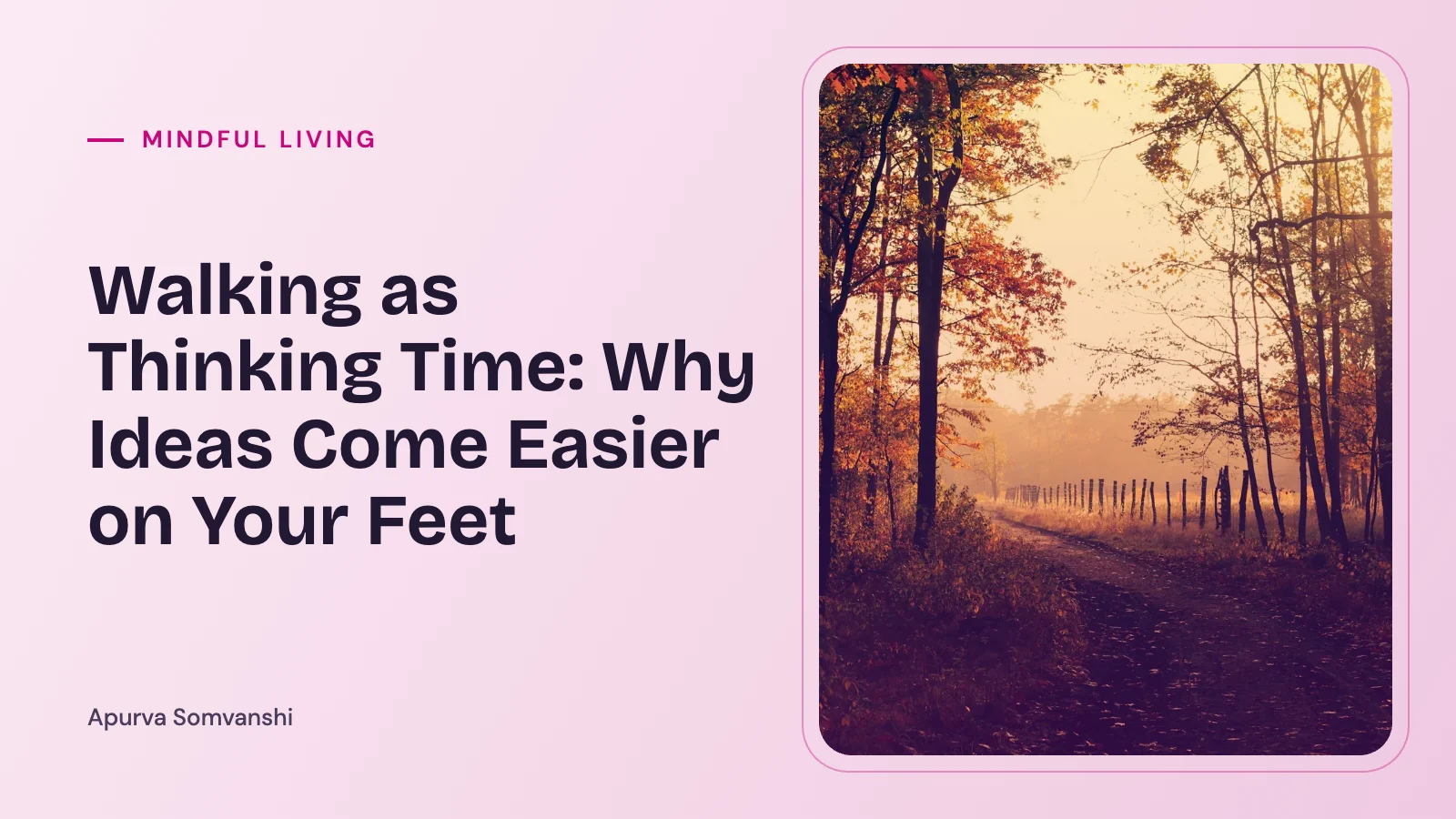
Cover image: Photo by Lukasz Szmigiel on Unsplash.
Worth remembering
People who walked and then sat down still did better on the creativity task than those who sat throughout.
Try this
Take one problem with you on a short walk this week, leave the headphones off, and record any ideas as a voice note.
Check what stuck
Tap a card to turn it over.
Apurva Somvanshi
Educator working in inclusive practice and SEND across primary and secondary schools, currently studying for an MSc in Psychology. I write about how children learn, how parents can help, and how adults can live with more attention.
Read my storyKeep reading
Mindful Living 3 min read
Gratitude Without Forcing It

Mindful Living 3 min read
Digital Rest: Giving Your Mind Space from the Screen

Mindful Living 4 min read
The Art of Slowing Down: Why Living in the Present Matters More Than Chasing Success
Questions about your child, your class or your next step? Let us talk.
Tell me a little about what is going on and I will reply within a few days.