Seating Plans That Help Every Pupil Learn
A practical guide to inclusive seating plans: what research says about rows and groups, how to plan for SEND, and how to review a plan so it keeps working.
ABy Apurva Somvanshi10 December 20247 min read
Work with me
Book a session
One-to-one support for children, parents and young professionals.
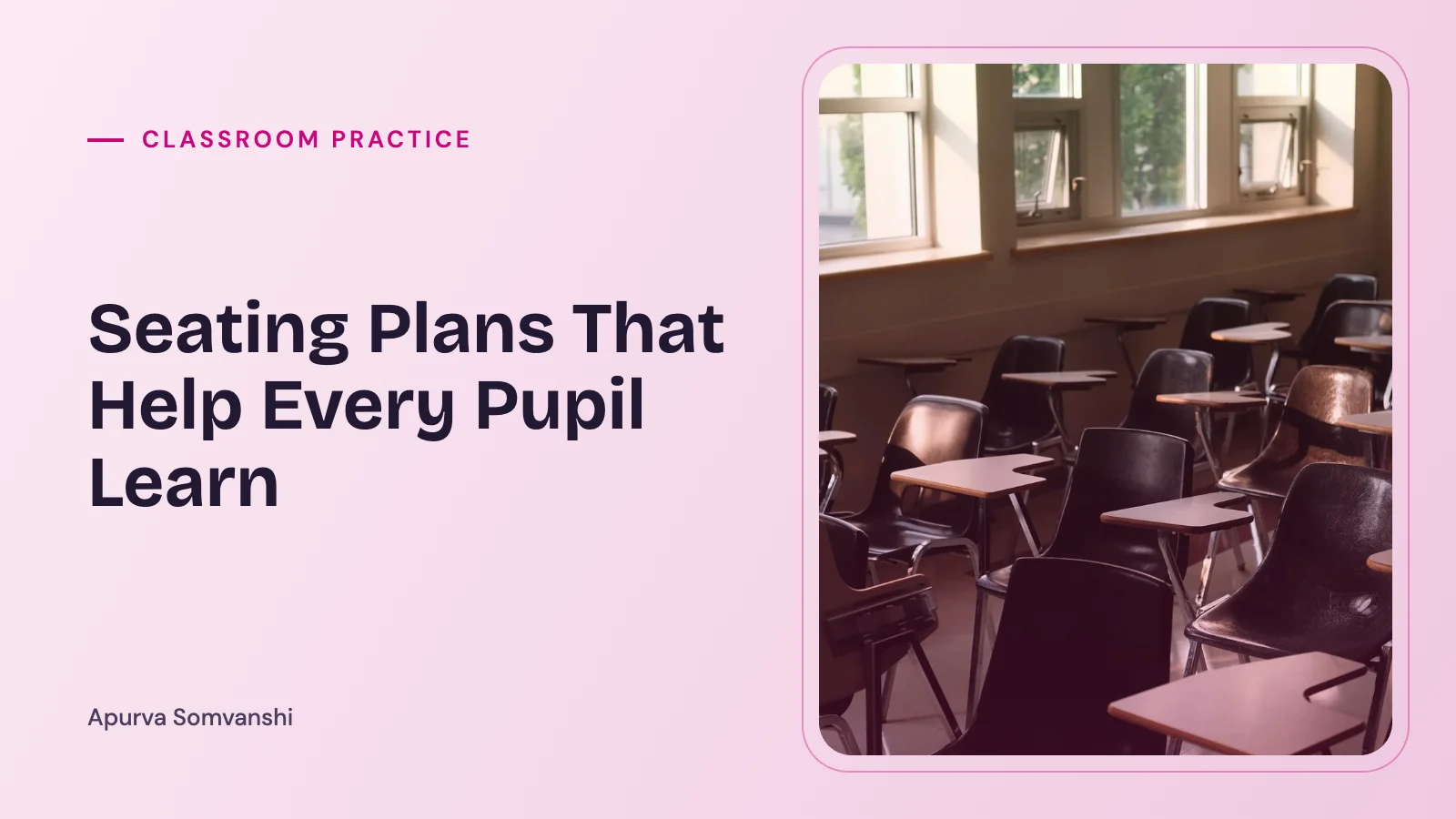
See programmesA seating plan is one of the few things a teacher can change before a lesson starts that affects every minute of it. Who sits where shapes who talks to whom, who can see the board, who gets distracted, and who quietly disappears at the back. It also tells pupils something about how the room works.
Many schools now expect seating plans for every class, often with SEND, pupil premium and other information marked on them. That can turn the plan into an administrative task. It is worth treating it as a teaching decision instead.
Rows, groups or horseshoe?
There is less research on classroom seating than you might expect, but what there is points in a sensible direction: the layout should suit the task.
Nichole Wannarka and Kathy Ruhl (2008), reviewing eight studies in Support for Learning, found that pupils seated in rows showed more on-task behaviour during independent work than pupils seated in clusters, and that pupils with the most disruptive behaviour benefited most from rows. A small 2012 study by David Bicard and colleagues in the Journal of Applied Behavior Analysis, with one class of 21 fifth-grade pupils in the US, found something similar. During independent seatwork, disruption was lowest when the teacher assigned seats in rows. Whether pupils sat in rows or in groups, disruption at least doubled when they chose their own seats.
Wannarka and Ruhl also noted that clusters suited interactive tasks better. Separately, a German study by Alexandra Marx and colleagues (1999) observed fourth-grade lessons and found that children asked more questions when seated in a semicircle than in rows.
So there is no single correct layout. A useful way to think about it:
| Arrangement | Tends to suit | Watch out for |
|---|---|---|
| Rows or pairs facing the front | Explanation, modelling, independent practice, tests | Less peer discussion; pupils at the back can drift |
| Small groups | Collaborative tasks, practical work, discussion | Off-task chat during independent work; some pupils have their back to the board |
| Horseshoe or U-shape | Whole-class discussion, questioning, debate | Takes space; can be hard for larger classes |
If your lessons move between these, consider a base layout that works for most of the lesson and a quick, practised routine for switching. Pairs in rows, with pupils turning to the pair behind for group tasks, is a common compromise.
Start with access, then think about learning
When I build a plan, I find it helps to think in layers. The first layer is about whether every pupil can physically access the lesson. The second is about who sits with whom.
Access needs come first
Under the Equality Act 2010, schools must make reasonable adjustments for disabled pupils, and the SEND Code of Practice (2015) expects teachers to plan for the needs of pupils with SEN in their classes. Seating is one of the simplest adjustments available. Check the pupil’s SEN support plan, EHCP or any advice from specialists before deciding.
Things to consider:
- Hearing. A deaf pupil or a pupil with hearing loss may need a clear view of your face and of other pupils who speak, and to be away from noise sources such as projectors, corridors or open windows. Follow advice from the Qualified Teacher of the Deaf if the pupil has one.
- Vision. Distance from the board, glare from windows and the angle of the screen all matter. Again, specialist advice from a Qualified Teacher of Vision Impairment should guide the plan.
- Physical access. Wheelchair users and pupils with mobility needs need a clear route to their seat and to the door, and a seat that does not leave them isolated at the edge of the room.
- Sensory needs. Some pupils find busy, noisy areas overwhelming. A seat near the edge, away from the door and the main walkway, can lower the load. Sensory Overload in the Classroom has more ideas.
- Attention. Pupils who find it hard to stay focused often do better with fewer distractions in their line of sight. That may mean near the front, but not always directly in front of you; some pupils find that position stressful.
- Exit and regulation. A pupil with an agreed time-out card or movement break may need a seat from which they can leave quietly without crossing the room.
Plan these seats first, then build the rest of the room around them.
Then think about who sits with whom
Common approaches include:
- Mixed attainment pairs, so pupils can explain to each other. Avoid always placing the same “helper” next to a pupil who struggles; it can be tiring for one and limiting for the other.
- Separating pupils who distract each other, without making it feel like a punishment.
- Placing a pupil who speaks English as an additional language near a supportive peer, ideally one who shares their language for some tasks, while also giving them chances to work in English with others.
- Thinking about friendships and vulnerability. A pupil who is isolated or being unkindly treated should not be placed where they are exposed.
Information you have about pupils’ backgrounds or needs should inform the plan, but it should not be visible to pupils. A seating plan on the teacher’s screen should not show labels such as SEND or pupil premium if the class can see it.
Where the adults go
If a teaching assistant works in your class, decide together where they sit and how they move. The Education Endowment Foundation’s guidance on making best use of teaching assistants warns against TAs being permanently attached to the same pupils, because it can reduce those pupils’ contact with the teacher and their independence. A TA based near a group, rather than glued to one chair, can support several pupils and step back when they are coping. Making the Best Use of Teaching Assistants goes into this in more detail.
Think about your own position too. Can you see every pupil’s face from where you usually stand? Is there a route around the room that lets you reach every desk during independent work?
Introducing a new plan
How you introduce a plan affects how it is received. Some practical points:
- Have pupils line up and show them to their seats at the start of the lesson, or display the plan on the board as they come in.
- Present it as normal: “This is where you’ll sit for this half term.” Avoid explaining individual reasons in front of the class.
- If a pupil objects, listen briefly, acknowledge it, and offer to talk at the end of the lesson. Then follow through. Sometimes they have a reason you did not know about.
- Use names from the first day. A plan helps you learn them quickly.
Reviewing the plan
A plan made in September is a guess. Review it after two or three weeks, and then at natural points such as half term. Questions worth asking:
- Is anyone regularly off task, and is their seat part of the reason?
- Are any pupils rarely contributing? Could they sit somewhere easier to include in questioning? (See Questioning That Brings Quieter Pupils In.)
- Have any new needs come to light, from the SENCO, parents or your own observation?
- Are any pairings no longer working?
Small changes are often enough. Moving two or three pupils can shift the feel of a room.
A note on choice
Some teachers let older pupils choose seats, sometimes as a privilege. There can be a place for that, especially in sixth form. The research above suggests that for independent work, chosen seats with friends are often more distracting. More importantly, free choice can leave some pupils visibly alone. If you do offer choice, it helps to do it within a structure, for example choosing from a few options you have already planned.
Further reading
- Bicard, D. F. et al. (2012). Differential effects of seating arrangements on disruptive behavior of fifth grade students during independent seatwork. Journal of Applied Behavior Analysis, 45(2), 407-411.
- Department for Education and Department of Health (2015). Special educational needs and disability code of practice: 0 to 25 years. GOV.UK.
- Education Endowment Foundation (2015, updated 2018). Making Best Use of Teaching Assistants: Guidance Report.
- Equality Act 2010. Legislation.gov.uk.
- Marx, A., Fuhrer, U. and Hartig, T. (1999). Effects of classroom seating arrangements on children’s question-asking. Learning Environments Research, 2, 249-263.
- Wannarka, R. and Ruhl, K. (2008). Seating arrangements that promote positive academic and behavioural outcomes: a review of empirical research. Support for Learning, 23(2), 89-93.
Worth remembering
Under the Equality Act 2010, schools must make reasonable adjustments for disabled pupils, and seating is one of the simplest adjustments available.
Try this
Check your current seating plan against each pupil's support plan or EHCP, and place access-need seats first.
Check what stuck
Tap a card to turn it over.
Apurva Somvanshi
Educator working in inclusive practice and SEND across primary and secondary schools, currently studying for an MSc in Psychology. I write about how children learn, how parents can help, and how adults can live with more attention.
Read my storyKeep reading
Classroom Practice 6 min read
Group Work That Includes Everyone
Classroom Practice 3 min read
Teaching English to Young Learners: Practical First Steps
Classroom Practice 5 min read
Reflective Practice for Teachers: Quick, Honest and Useful
Questions about your child, your class or your next step? Let us talk.
Tell me a little about what is going on and I will reply within a few days.