Group Work That Includes Everyone
Why group work often leaves some pupils out, and how cooperative learning principles from Johnson and Johnson help every pupil take part and learn.
ABy Apurva Somvanshi25 September 20266 min read
Work with me
Book a session
One-to-one support for children, parents and young professionals.
See programmesMost teachers have seen group work go wrong in the same few ways. One pupil does everything. Two chat about the weekend. Someone with a quieter voice, or less confidence in English, or a need that makes the noise and pace hard to manage, sits at the edge and copies down what the others decide. At the end, the group produces a poster, and it is hard to say what anyone learned.
None of this means group work is a bad idea. It means that putting pupils at the same table is not the same as asking them to work together. The difference lies in how the task is built.
What the evidence says
The Education Endowment Foundation’s Teaching and Learning Toolkit rates collaborative learning approaches as very low cost, with an average impact of around five months’ additional progress over a year. The EEF also rates the strength of that evidence as low, partly because many studies are old or were not independently run, and results vary a lot. Its summary is clear that structured approaches with well-designed tasks get the best results, and that without careful design some pupils will struggle to take part or will end up working alone.
That variation is the useful part. Collaborative learning can work well, and it can also achieve very little. What separates the two is structure.
Five elements from cooperative learning
David Johnson and Roger Johnson spent decades researching what they call cooperative learning, drawing on social interdependence theory. In a 2009 review in Educational Researcher, they summarised the elements that make cooperation work. I find them a practical checklist when planning.
1. Positive interdependence
Pupils need to need each other. If one person could complete the task alone, someone usually will. Ways to build interdependence include giving each pupil a different piece of information, a different role, or a part of the final product that the group cannot finish without.
2. Individual accountability
Each pupil must be responsible for their own learning as well as the group’s outcome. Without this, the well-known “social loafing” effect sets in: in a classic 1979 study, Bibb Latané, Kipling Williams and Stephen Harkins found that people put in less effort when working in a group than alone. In the classroom, accountability can be as simple as telling the group that anyone might be asked to explain the answer, then choosing at random.
3. Promotive interaction
Pupils help, explain to and encourage each other face to face. This is where much of the learning happens, especially when pupils have to put their reasoning into words.
4. Social skills
Taking turns, disagreeing politely, checking that everyone understands: these need teaching. Pupils are not born knowing how to do them, and some pupils, including some with social communication needs, will need them made very explicit.
5. Group processing
Groups reflect briefly on how they worked together and what they would change. Even a one-minute check (“What helped your group today? What will you do differently?”) makes the skill visible.
Structures that work
You do not need elaborate projects to use these ideas. Short, well-defined structures often work better.
Think, pair, share
Pupils think alone first, then discuss with a partner, then some pairs share with the class. The silent thinking time is especially helpful for pupils who process more slowly or who are learning English.
Jigsaw
Developed by Elliot Aronson and colleagues in the 1970s, the jigsaw method gives each member of a “home” group a different piece of material. Pupils first meet with others who have the same piece to become “experts”, then return home to teach their group. Everyone holds information the group needs.
Numbered heads
Each group member has a number. The group works on a question and makes sure everyone can answer. The teacher then calls a number, and that pupil answers for the group.
Roles
Roles such as reader, scribe, timekeeper, questioner or checker give each pupil a defined job. Rotate them so that the same pupil is not always the scribe or always the reporter. Roles should be real; if the “timekeeper” never has to say anything, the role adds nothing.
Making it inclusive
Group work can be one of the best opportunities for pupils with SEND, or pupils new to English, to use language and learn from peers. It can also be one of the most exposing. A few things help.
Plan the groups. Random grouping has its place, but for most tasks it helps to think about who will work well together. Groups of three or four are usually easier to manage than larger ones, and the EEF summary points to small groups as the most successful structure.
Give every pupil a way in. A pupil who finds writing hard can be the one who sorts cards, draws the diagram, or explains orally. A pupil learning English can work with a sentence starter or a word bank, and with a partner who shares their language where that is appropriate.
Make the task visible. Clear written instructions, a visual reminder of the steps, and a timer on the board reduce the load for pupils who struggle with working memory or attention.
Think about noise and space. For some pupils, especially those with sensory needs, the sound of a busy classroom is hard to work in. A group table in a quieter corner, or permission to step away for a short break, can make the difference between joining in and shutting down.
Teach the social skills. Some pupils need explicit modelling of what turn-taking or polite disagreement sounds like. Short scripts can help: “I see it differently because…”, “Can you explain that again?”
Watch the dynamics. Circulate, listen, and notice who is speaking. If one pupil is always silent, find out why. It might be confidence, language, a friendship issue, or a need you were not aware of.
If you have a teaching assistant, they can support a group rather than sitting with one pupil, which helps that pupil take part with peers. Making the Best Use of Teaching Assistants covers this in more depth.
Assessing group work fairly
If the grade or praise goes only to the product, pupils who did little benefit and pupils who did a lot may resent it. Ways round this include short individual tasks after the group work, asking each pupil to explain part of the outcome, or brief self and peer reflections. Keep the focus on learning rather than on the poster.
A sensible balance
Group work is one tool among many. Explicit teaching, modelling and independent practice all matter too, and some content is better learned alone first. A useful rhythm is often: teach clearly, let pupils practise independently, then use structured group work to discuss, apply or explain. See Questioning That Brings Quieter Pupils In and Seating Plans That Help Every Pupil Learn for related ideas.
Further reading
- Aronson, E. and Patnoe, S. (2011). Cooperation in the Classroom: The Jigsaw Method (3rd ed.). Pinter and Martin.
- Education Endowment Foundation. Teaching and Learning Toolkit: Collaborative learning approaches.
- Johnson, D. W. and Johnson, R. T. (2009). An educational psychology success story: social interdependence theory and cooperative learning. Educational Researcher, 38(5), 365-379.
- Latané, B., Williams, K. and Harkins, S. (1979). Many hands make light the work: the causes and consequences of social loafing. Journal of Personality and Social Psychology, 37(6), 822-832.
- Slavin, R. E. (1996). Research on cooperative learning and achievement: what we know, what we need to know. Contemporary Educational Psychology, 21(1), 43-69.
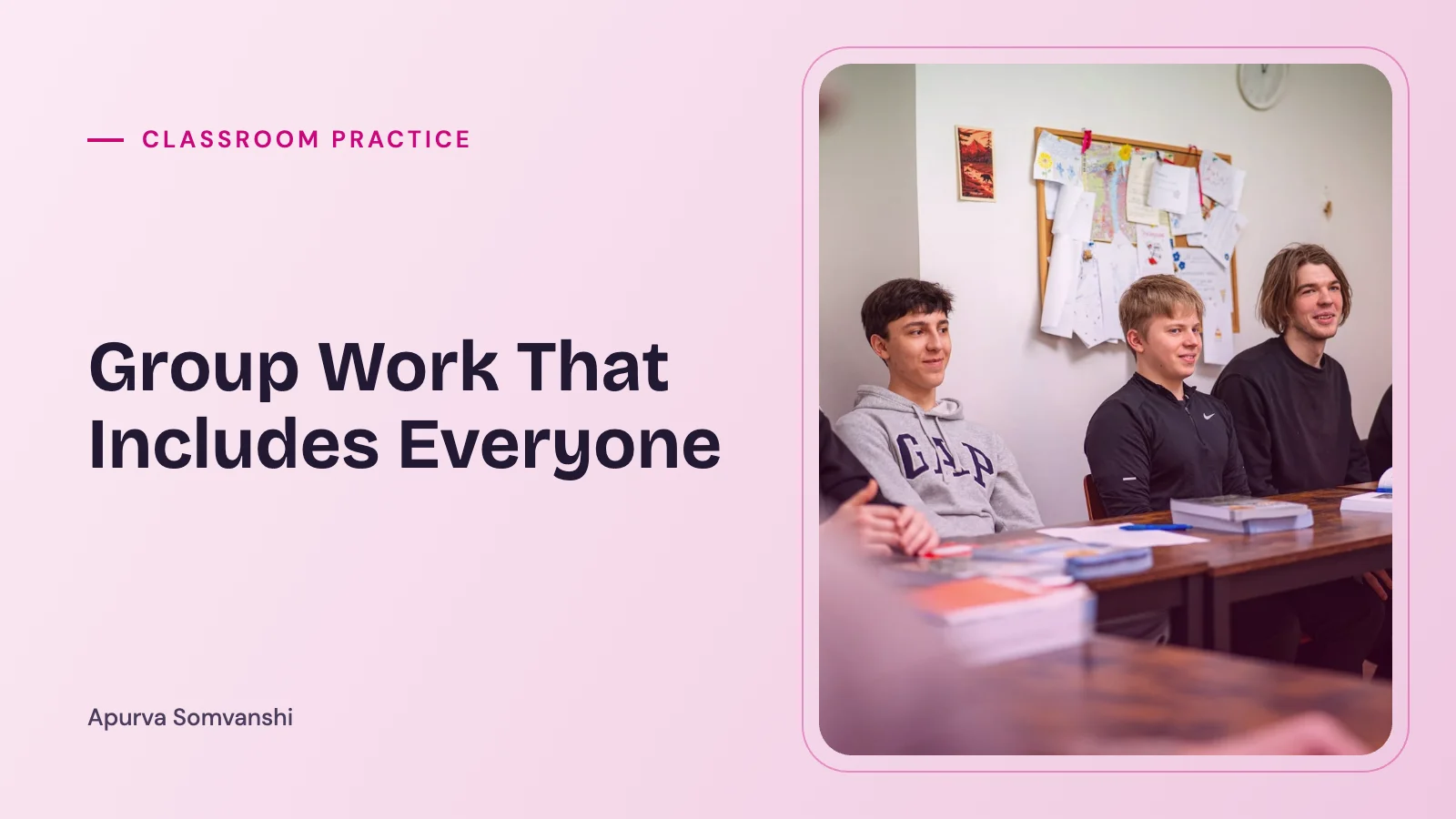
Cover image: Photo by Timur Shakerzianov on Unsplash.
Worth remembering
Groups of three or four are usually easier to manage, and the EEF summary points to small groups as the most successful structure.
Try this
In your next group task, tell pupils anyone might be asked to explain the answer, then choose a pupil at random.
Check what stuck
Tap a card to turn it over.
Apurva Somvanshi
Educator working in inclusive practice and SEND across primary and secondary schools, currently studying for an MSc in Psychology. I write about how children learn, how parents can help, and how adults can live with more attention.
Read my storyKeep reading
Classroom Practice 3 min read
Teaching English to Young Learners: Practical First Steps
Classroom Practice 5 min read
Reflective Practice for Teachers: Quick, Honest and Useful
Classroom Practice 4 min read
Dual Coding: Using Visuals in Teaching Without the Clutter
Questions about your child, your class or your next step? Let us talk.
Tell me a little about what is going on and I will reply within a few days.