Emotional Regulation in the Early Years: How Children Learn to Calm Down
How emotional regulation develops from birth to five, why co-regulation comes first, and simple ways adults can help young children manage big feelings.
ABy Apurva Somvanshi7 January 20257 min read
Work with me
Book a session
One-to-one support for children, parents and young professionals.
See programmesA three-year-old who throws a cup across the room because it is the wrong colour is not being dramatic for the sake of it. Their feelings arrive fast and full-sized, and the parts of the brain that help an older child pause and choose a response are still years from finished. Emotional regulation is something children learn, slowly, and mostly through the adults around them.
This piece looks at what emotional regulation means, how it usually develops between birth and five, and what helps along the way.
What emotional regulation means
Psychologists use “emotion regulation” for the ways we influence which feelings we have, when we have them, and how we experience and express them. James Gross, whose 1998 review in the Review of General Psychology shaped much of the research since, described it as a set of processes rather than a single skill. Some happen before a feeling builds (avoiding a situation, or seeing it differently). Others happen once the feeling is already there (breathing slowly, walking away, asking for a hug).
For young children, almost all of this starts outside them. A baby cannot decide to see a cold nappy change differently. They cry, and an adult does the regulating: picks them up, speaks softly, sorts the problem. Over time, children take more of that work on themselves.
How it develops from birth to five
Claire Kopp’s 1982 paper in Developmental Psychology set out a broad sequence that is still widely used. Very young babies rely on reflexes and on caregivers. Through the first year they start to respond to the world around them in more organised ways. By the toddler years they can follow simple instructions and stop an action when asked. Later still, they begin to manage their own behaviour without a reminder, and eventually to plan how to cope.
In everyday terms, you might notice:
- Babies soothe a little by sucking, turning away from too much noise or light, and settling when held. Mostly, they need an adult.
- Toddlers have strong feelings and very few ways to manage them. They may hit, bite or collapse on the floor. They also begin to look to a trusted adult’s face to work out whether something is safe or frightening.
- Three- and four-year-olds start to use words for feelings, can sometimes wait a short while, and may use a comfort object or a familiar routine to settle.
- Four- and five-year-olds can often name a feeling, remember a strategy they have been taught, and recover more quickly after an upset, though tiredness and hunger still knock this back.
Children vary a great deal. Temperament, language development, sleep, and any special educational needs all affect the pace. A child who is late to talk, for example, may have fewer ways to tell you what is wrong and more reason to show it with their body.
In England, the Early Years Foundation Stage includes Self-Regulation as one of the early learning goals within Personal, Social and Emotional Development. By the end of Reception, children at the expected level show an understanding of their own feelings and those of others and begin to regulate their behaviour accordingly; they can wait for what they want and control their immediate impulses when appropriate. The word “begin” matters there. Even at five, this is early work.
Co-regulation comes first
Before a child can calm themselves, they need many experiences of being calmed by someone else. This is co-regulation: a warm, steady adult lending the child their own calm until the child can manage more on their own.
Katie Rosanbalm and Desiree Murray, in a practice brief for the US Office of Planning, Research and Evaluation, describe three parts to co-regulation:
- A warm, responsive relationship, so the child feels safe enough to be soothed.
- A structured environment, with predictable routines and fewer avoidable triggers.
- Teaching and coaching, where adults model calming strategies and practise them with the child.
What I like about this framing is that it moves the focus from the child’s behaviour to the adult’s. In a meltdown, the most useful question is often “How calm am I right now?” A raised voice tends to raise a child’s distress. A lower, slower voice, fewer words and a relaxed posture give the child something to match.
Naming feelings
Putting a word to a feeling seems to help. In an often-cited 2007 study in Psychological Science, Matthew Lieberman and colleagues found that when adults labelled the emotion in a picture of a face, activity in the amygdala (a brain area involved in threat responses) dropped compared with simply looking at it. That study was with adults, so it cannot tell us exactly what happens in a toddler’s brain. Still, it fits with what many early years practitioners see: a child who hears “You’re cross because the tower fell down” often settles a little, because they feel understood.
Some practical points:
- Name the feeling you think the child has, then the reason. “You’re sad. You wanted to stay at the park.”
- Keep it short when the feeling is big. Long explanations can wait.
- Accept the feeling even when you stop the behaviour. “You’re angry. I won’t let you hit. You can stamp your feet.”
- Use feelings words in calm moments too: in stories, during play, when talking about your own day.
There is more on this in Naming Feelings: Helping Children Talk About Emotions.
What helps at home and in settings
Routines. Predictable days lower the number of surprises a child has to cope with. A visual timetable can help in nursery or at home, especially for children who find change hard.
Warnings before transitions. “Two more turns on the slide, then shoes on” gives a child time to prepare. Many meltdowns happen at the point of change.
Basic needs. Hunger, tiredness and overstimulation make regulation much harder for anyone. A snack or an early night is sometimes the best behaviour strategy available.
A calm space. A quiet corner with cushions and a few soft toys can be a place to go and settle, ideally with an adult nearby at first. This is different from sending a child away. See Calm-Down Corners: A Gentler Alternative to Time-Out.
Simple body strategies. Slow breaths (“smell the flower, blow out the candle”), a tight squeeze of a cushion, or pushing hands against a wall can help some children. Practise these when the child is calm so they are familiar when needed.
Repair afterwards. Once everyone is calm, a short, kind conversation helps: what happened, what the child felt, what might help next time. Keep it brief for young children. Repair also teaches that relationships survive hard moments.
Tantrums are part of the process
It can feel as if frequent tantrums mean something is going wrong. For toddlers and young preschoolers, they are a normal sign that feelings have outrun the child’s skills. The aim is gradually fewer, shorter, less intense episodes, and a child who recovers with less help over time. If you would like to understand the difference between a tantrum and a sensory or emotional meltdown, see Tantrums and Meltdowns: What’s the Difference?.
When to get advice
Most children grow steadily in their ability to manage feelings, with plenty of wobbles. It is worth speaking to your health visitor, GP, or your child’s nursery or school SENCO if:
- outbursts are very frequent, very long, or getting worse rather than better over several months
- your child often hurts themselves or others during upsets
- difficulties with feelings come alongside concerns about speech, social interaction, sleep or eating
- you are finding it hard to cope yourself
Asking for advice is not a failure. Health visitors and early years staff support many families with exactly this. If anyone is in immediate danger, call 999.
Further reading
- Gross, J. J. (1998). The emerging field of emotion regulation: an integrative review. Review of General Psychology, 2(3), 271-299.
- Kopp, C. B. (1982). Antecedents of self-regulation: a developmental perspective. Developmental Psychology, 18(2), 199-214.
- Lieberman, M. D. et al. (2007). Putting feelings into words: affect labeling disrupts amygdala activity in response to affective stimuli. Psychological Science, 18(5), 421-428.
- Rosanbalm, K. D. and Murray, D. W. (2017). Co-Regulation From Birth Through Young Adulthood: A Practice Brief. OPRE Brief 2017-80. Office of Planning, Research and Evaluation, US Department of Health and Human Services.
- Department for Education. Help for early years providers: Self-Regulation early learning goal. GOV.UK.
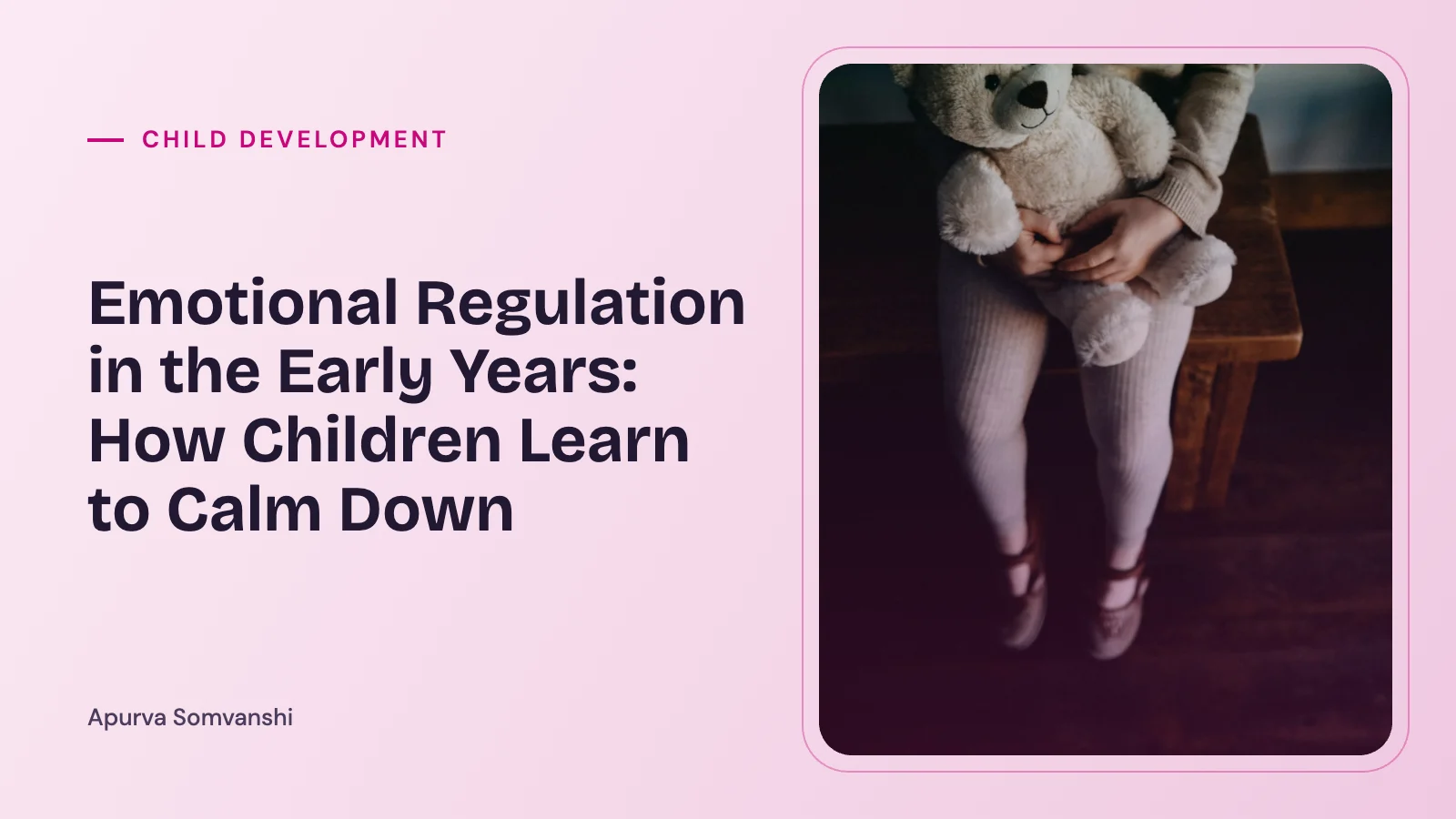
Cover image: Photo by Annie Spratt on Unsplash.
Worth remembering
In a 2007 study with adults, labelling the emotion in a picture of a face reduced activity in the amygdala compared with simply looking at it.
Try this
Practise one body strategy, like 'smell the flower, blow out the candle', with your child at a calm moment this week.
Check what stuck
Tap a card to turn it over.
Apurva Somvanshi
Educator working in inclusive practice and SEND across primary and secondary schools, currently studying for an MSc in Psychology. I write about how children learn, how parents can help, and how adults can live with more attention.
Read my storyKeep reading
Child Development 3 min read
Executive Function, Explained for Parents

Child Development 3 min read
Serve and Return: Everyday Conversations That Build Young Brains
Child Development 3 min read
Growth Mindset: What the Research Does and Doesn’t Say
Questions about your child, your class or your next step? Let us talk.
Tell me a little about what is going on and I will reply within a few days.