Fine Motor Skills and Handwriting: Play Comes First
Strong hands come before neat handwriting. Play ideas that build fine motor skills, what research says about pencil grip, and when to ask about OT.
ABy Apurva Somvanshi30 December 20246 min read
Work with me
Book a session
One-to-one support for children, parents and young professionals.
See programmesWhen a young child struggles with writing, the instinct is often to give them more writing practice. Worksheets, tracing, copying letters. Sometimes that helps. Often, though, the difficulty sits further back, in the hands, fingers, shoulders and core strength that writing depends on.
Handwriting is one of the most demanding physical tasks we ask young children to do. It needs a stable body, a strong but relaxed hand, fingers that can move separately from each other, and eyes and hands working together. Most of that is built through play long before a child picks up a pencil with any purpose.
What fine motor skills are
Fine motor skills are the small, precise movements of the hands and fingers. Picking up a raisin, turning a page, doing up a button, snipping with scissors, threading a bead.
They rely on several things working together:
- Postural stability. A child who cannot sit steadily will find it hard to control their hand. Core and shoulder strength matter more than people expect.
- Hand strength and arches. The small muscles of the hand need to be strong enough to hold a tool without gripping too tightly.
- Finger separation. Writing uses the thumb, index and middle fingers for control, while the other two fingers stabilise.
- Bilateral coordination. One hand works while the other holds the paper steady.
- Hand-eye coordination. The eyes guide the hand to where it needs to go.
Play before pencils
The good news is that the best preparation for handwriting is the kind of play most children already enjoy. These activities build strength and control without any pressure to form letters:
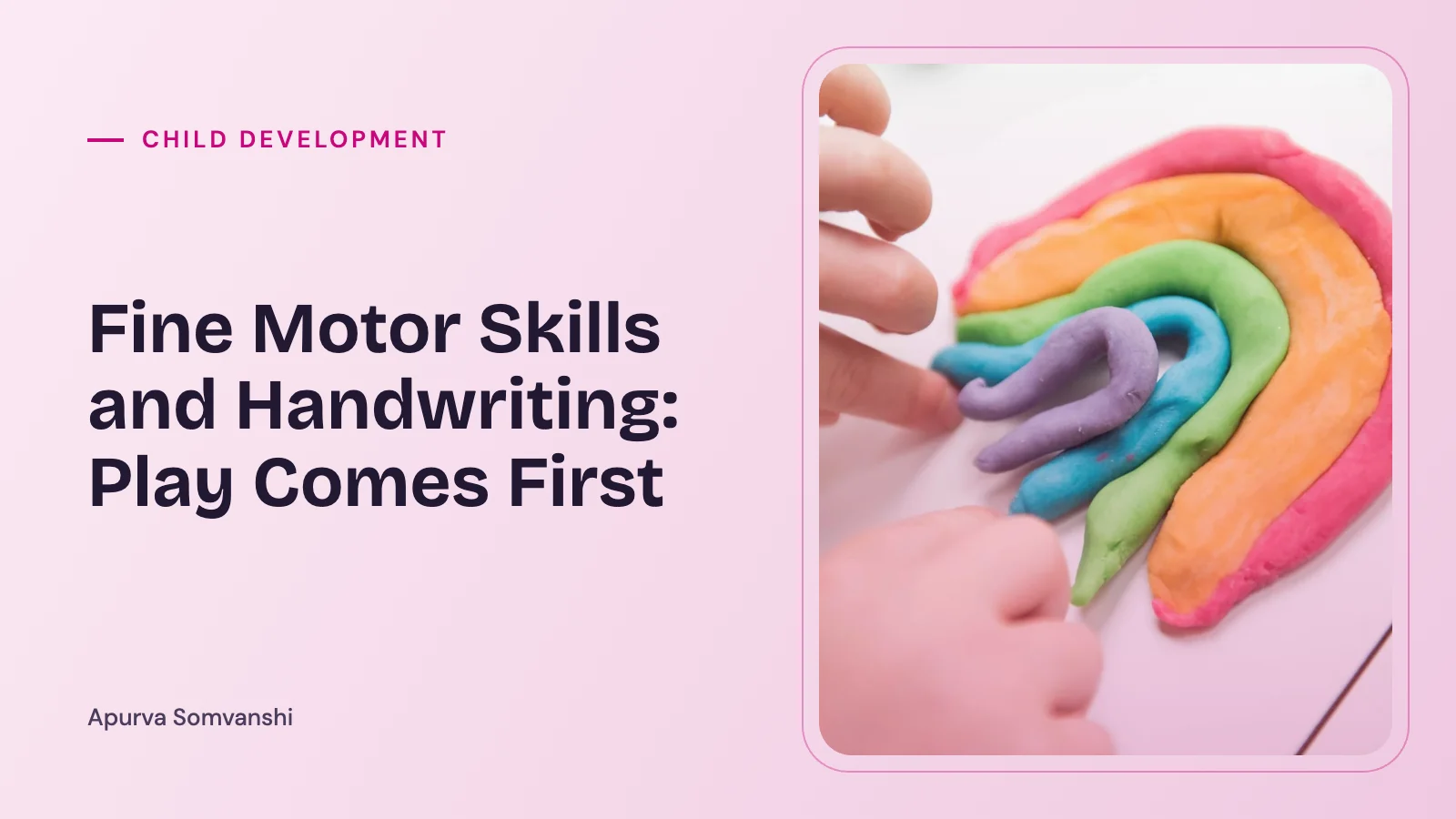
- Squeezing, rolling and pinching playdough or clay
- Tearing paper and scrunching it into balls
- Picking up small objects with fingers, tongs or tweezers
- Threading beads, pasta or cotton reels
- Building with small bricks and construction toys
- Pegging washing or pegs onto the edge of a box
- Using spray bottles to water plants
- Posting coins into a money box
- Painting at an easel or on a wall, which builds shoulder strength and a good wrist position
- Climbing, crawling, hanging from bars and pushing wheelbarrows, all of which strengthen the shoulders and core that support the hand
- Helping in the kitchen: stirring, kneading, spreading and pouring
Big movements come first. Children tend to develop control from the centre of the body outwards, so large arm movements on big surfaces, such as chalk on the patio or paint on a roll of wallpaper, are useful before small marks on small paper.
You can read more about why open-ended play matters in Play Is Learning.
Pencil grip: what the research says
Children’s grip changes as they grow. In 1990, Colleen Schneck and Anne Henderson studied how typically developing young children held crayons and pencils. They described a broadly predictable progression with age, from whole-hand grasps, with the crayon held in a fist, towards mature grips that use the fingertips.
The grip most often taught is the dynamic tripod: the pencil held between the thumb and index finger, resting on the middle finger. The Early Years Foundation Stage early learning goal for fine motor skills in England expects children at the end of Reception to “hold a pencil effectively in preparation for fluent writing, using the tripod grip in almost all cases”.
Research has added a useful nuance. A 2012 study by Heidi Schwellnus and colleagues, in the Australian Occupational Therapy Journal, compared four mature grips in Grade 4 children (roughly Year 5 in England) during a ten-minute copying task. They found no difference in speed or legibility between the dynamic tripod and the other mature grips: the lateral tripod, the dynamic quadrupod and the lateral quadrupod. The authors suggested this calls into question the practice of insisting that every child adopt the dynamic tripod.
In practice, I think this means: help young children towards a comfortable, efficient grip through play and gentle modelling, but do not battle with an older child whose different grip is comfortable, legible and fast enough. What matters more is whether the grip causes pain, fatigue or very slow writing.
Small things that help
- Short pencils, broken crayons and chunky chalk naturally encourage a fingertip grip because there is no room for a fist.
- Writing on a vertical or sloped surface, such as an easel or a slope board, can encourage a better wrist position.
- Check seating. Feet flat on the floor, table at about elbow height, and the paper angled slightly.
- Pencil grips can help some children, but are worth trying with advice rather than as a first fix.
Handwriting at school
Once children start formal letter formation, short and frequent practice tends to work better than long sessions. Correct formation from the start, such as starting letters in the right place, saves a lot of unlearning later.
Some children will find handwriting hard despite plenty of practice. Messy writing on its own is not a diagnosis. But difficulties that persist alongside other signs are worth noticing.
When to get help
The NHS lists difficulties with handwriting, drawing and using scissors among the possible signs of developmental co-ordination disorder (DCD), also known as dyspraxia, along with trouble with dressing, buttons, shoelaces, ball skills and frequent clumsiness. Clumsiness alone is not necessarily a sign of DCD.
Talk to your child’s teacher or the school SENCO, and to your GP or health visitor, if your child:
- avoids drawing, colouring or writing, or becomes very upset by it
- complains that their hand hurts when writing
- is much slower than classmates at writing, despite effort
- still struggles with everyday tasks such as buttons, cutlery or scissors well beyond the age you would expect
- has difficulties with balance, coordination or ball skills as well
A children’s occupational therapist (OT) can assess motor skills and suggest specific activities and adjustments. Referral routes vary: some areas accept referrals from schools or parents directly, others go through the GP. School can also put support in place through SEN support while you wait. Working Well with Your Child’s SENCO covers how to start that conversation.
Further reading
- Department for Education. ELG: Gross and Fine Motor Skills. Help for early years providers. gov.uk.
- NHS. Developmental co-ordination disorder (dyspraxia) in children: symptoms. nhs.uk.
- Schneck, C. M. and Henderson, A. (1990). Descriptive analysis of the developmental progression of grip position for pencil and crayon control in nondysfunctional children. American Journal of Occupational Therapy, 44(10), 893-900.
- Schwellnus, H. et al. (2012). Effect of pencil grasp on the speed and legibility of handwriting after a 10-minute copy task in Grade 4 children. Australian Occupational Therapy Journal, 59(3), 180-187.
- National Handwriting Association. Resources for parents and teachers. nha-handwriting.org.uk.
Cover image: Photo by Julietta Watson on Unsplash.
Worth remembering
A 2012 study of Grade 4 children found that four mature pencil grips gave the same speed and legibility in a ten-minute copying task.
Try this
Set up a play session this week with playdough, tweezers and small objects, with no pressure to write letters.
Check what stuck
Tap a card to turn it over.
Apurva Somvanshi
Educator working in inclusive practice and SEND across primary and secondary schools, currently studying for an MSc in Psychology. I write about how children learn, how parents can help, and how adults can live with more attention.
Read my storyKeep reading
Child Development 3 min read
Executive Function, Explained for Parents

Child Development 3 min read
Serve and Return: Everyday Conversations That Build Young Brains

Child Development 3 min read
Growth Mindset: What the Research Does and Doesn’t Say
Questions about your child, your class or your next step? Let us talk.
Tell me a little about what is going on and I will reply within a few days.